
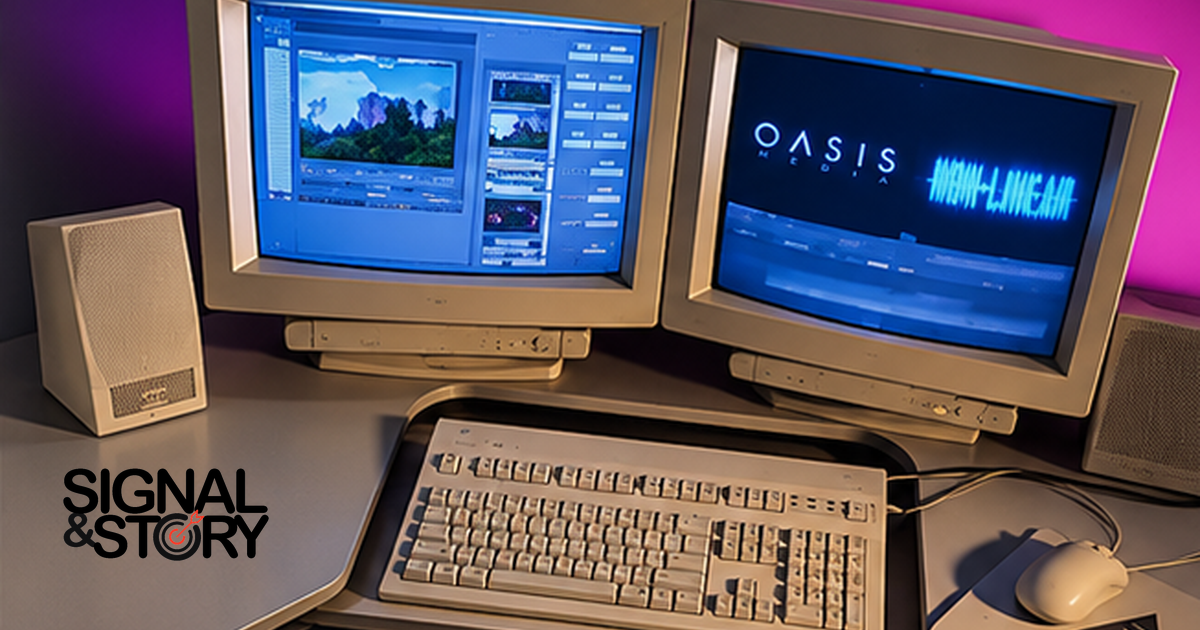
What Oasis Media taught me about new technology, and why the hard part of communications hasn’t moved.
When I started shooting video projects around Northern Nevada, the shooting happened here. The editing didn’t. Broadcast-quality editing meant a trip to San Francisco, and I made that drive often.
What the Drive Taught Me
Those trips showed me state-of-the-art production technology, the people who used it every day, and the connections that eventually helped me build Oasis Media in Reno.
Oasis grew into a digital production and postproduction facility with 11 employees. We served film, broadcast and Internet clients, including Discovery Channel, NBC Sports, MTV Sports, Caesars Palace and Southwest Airlines. The work covered digital video post-production, ProTools audio, Paintbox graphics, 3D animation and web content creation.
We did remarkable things with digital editing, animation and visual effects. Sometimes the technology advanced faster than we could keep up.
The Barrier Was Access
When broadcast-quality editing required a trip to San Francisco, the barrier was access to the tools. Oasis brought them to Reno, and we were the only game in town. Advertising agencies and celebrities were regular customers, and hourly rates started at $350, which is ridiculous by today’s standards.
That price shows how scarce the capability was. Only a small circle of clients could afford it, and everyone else made the drive or went without.
Access didn’t settle the important questions. Clients still needed someone who knew what story to tell and who it was for. The equipment carried out the idea. Deciding on the idea was still a person’s job.
The Same Shift Is Happening Again
I now use AI tools to build and update my websites and to handle work that once required considerable technical expertise.
What stands out is how accessible it is to people without a technical background. A small business owner, a program manager at a community organization or a staff member at a public agency can now draft a web page, rewrite copy or lay out a flyer in minutes. That used to take a specialist, or a long drive.
AI is doing for websites, copy and design what Oasis did for video. The tools are getting easier to reach. The hard part is where it has always been: knowing your audience, your message and what to say first.
A Practical Place to Start
If your organization is adopting AI, use it. It can save real time. Start with strategy, though, and settle three things before anyone opens a tool:
- Audience. Who are you speaking to, and what do they need from you?
- Message. What should they understand, or do, after they read it?
- Priorities. What comes first, and what can wait?
With those answers in hand, the tools work for you. Without them, you get more material faster, and no assurance that any of it says something worth saying.
The tools will keep getting easier to reach. Knowing your audience and your message will keep being the part that matters.
If you’re working out how AI fits into your communications, I’d enjoy talking it through. Stop by the Let’s Grab Coffee page and say hello.